AI Search Is Changing How Buyers Find Homes — Is Your Listing Ready?
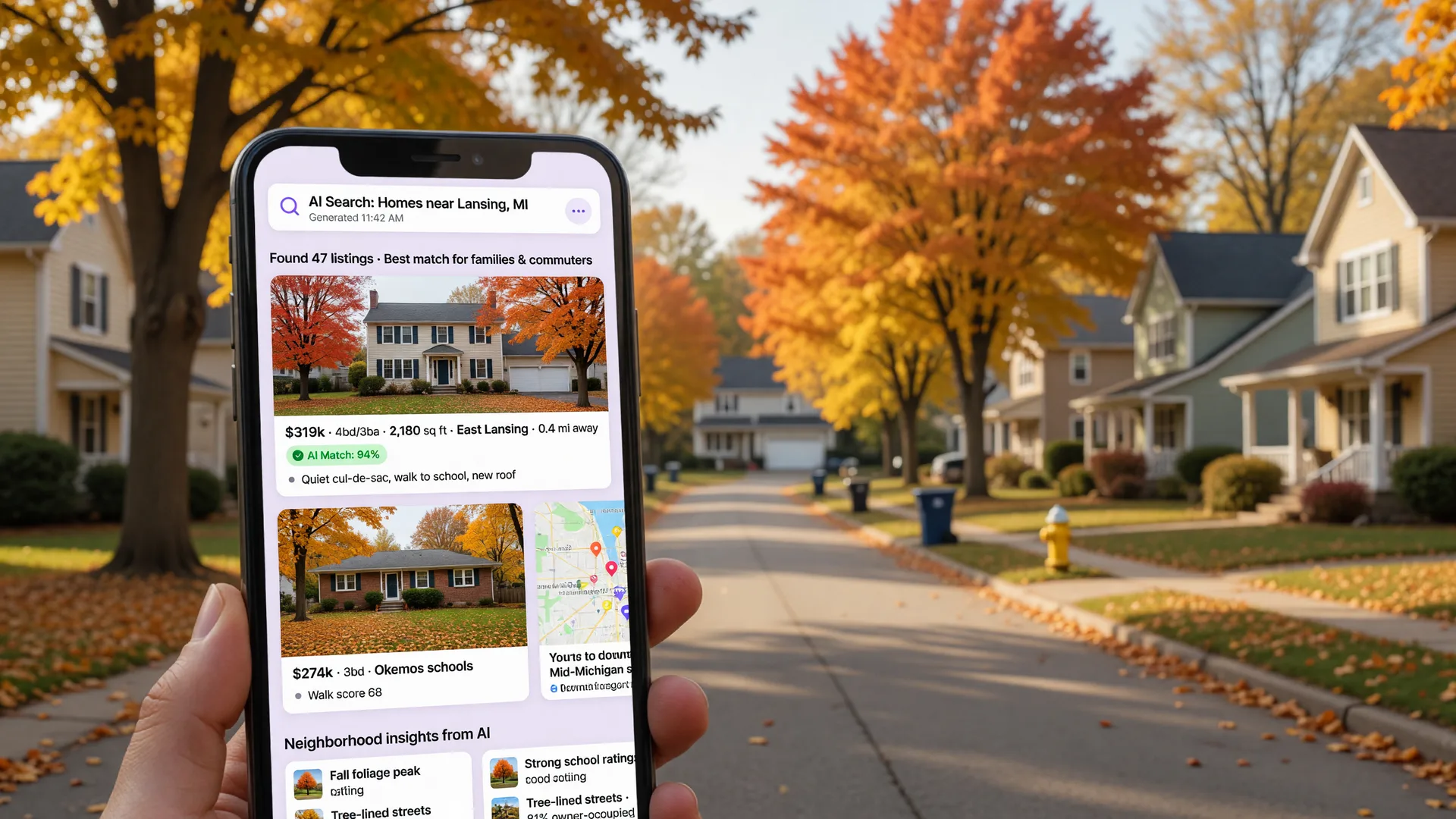
The way buyers find homes is changing — fast. A few years ago, most home searches started with a Google query and a scroll through JoyceEngland.com or Realtor.com. Today, a growing number of buyers are asking AI directly: "What are the best neighborhoods in Grand Blanc for families?" or "How much do homes near Fenton's lake communities typically sell for?" Tools like Google AI Overviews, ChatGPT, Perplexity, and other AI-powered answer engines are reshaping how people research communities, compare options, and ultimately choose which homes to tour. If you're selling a home in Mid-Michigan, understanding this shift isn't optional — it's essential.
What Are AI Answer Engines, and Why Do They Matter for Real Estate?
Traditional search engines return a list of blue links. AI answer engines do something fundamentally different: they synthesize information from multiple sources and deliver a direct, conversational response. When a relocating buyer types "best places to live near Flint, Michigan" into ChatGPT or Perplexity, they don't get ten competing websites to sift through — they get a curated answer that highlights specific neighborhoods, price ranges, school districts, and lifestyle features.
For real estate, this is a seismic shift. The homes and communities that AI answer engines reference are the ones buyers will notice. If your listing's information is well-structured, accurate, and easy for AI systems to find and interpret, it's more likely to surface in these answers. If it isn't, your property may be invisible to an entire segment of buyers who never scroll past the AI-generated response.
How Buyers in Mid-Michigan Are Using AI to Research Homes
Mid-Michigan is a region that attracts a lot of relocation interest. Professionals transferring to General Motors, McLaren Health Care, or the University of Michigan, remote workers choosing Michigan for its affordability, and families relocating from out of state all share one thing in common: they often start their research online, often with AI tools, before they ever contact an agent. Here's what I'm seeing in practice:
- Neighborhood discovery: Buyers ask AI to compare communities — "What's the difference between Fenton and Linden?" or "Is Grand Blanc a good area for young families?" AI tools pull together school data, median home prices, commute times, and lifestyle factors to deliver a summary that shapes the buyer's short list.
- Market condition research: Buyers use AI to understand pricing trends — "Is it a buyer's or seller's market in Oakland County?" or "How have home prices changed in Davison over the past two years?" These questions generate direct answers that influence when and where buyers make offers.
- Lifestyle and amenity matching: Relocating buyers ask about things that matter to their daily life — walkability, proximity to trails and parks, local dining and shopping, healthcare access, and community events. AI tools that can pull this information from local sources create a richer picture for the buyer.
The common thread is that AI is compressing the research phase. Buyers who might have spent weeks browsing listings and reading blogs are now getting targeted, synthesized answers in minutes. The agents and listings that show up in those answers have a measurable advantage.
What Answer Engine Optimization (AEO) Means for Sellers
You've probably heard of SEO — Search Engine Optimization — the practice of making your online content rank well in Google search results. Answer Engine Optimization, or AEO, is the next evolution. It's the practice of structuring your content so that AI systems can easily find, understand, and surface it when users ask relevant questions.
For a home seller, AEO touches several critical elements:
- Listing descriptions that answer real questions: A well-written listing doesn't just describe a home's features — it anticipates the questions buyers are asking. What school district does this home serve? What's the commute to downtown Flint or Pontiac? What upgrades have been done? AI systems pull answers from listings that are written clearly, with specific details and structured information.
- Neighborhood and community content: AI answer engines rely on rich, accurate local content to generate their responses. When a listing is supported by detailed community information — neighborhood guides, school data, local amenities, and lifestyle context — it becomes a more authoritative source that AI tools are more likely to reference.
- Consistent, accurate information across platforms: AI systems cross-reference data from multiple sources. If your home's details on JoyceEngland.com, Realtor.com, your single-property website, and your agent's marketing all tell a consistent story, AI tools are more confident in surfacing that information. Conflicting data reduces that confidence.
- Structured data and metadata: Behind the scenes, properly structured website data — schema markup, clear headings, organized content — helps AI systems parse and categorize your listing information more effectively. This is technical work, but it has a direct impact on discoverability.
How I Use AI-Powered Content Strategy for My Listings
This is where my background in marketing and my embrace of AI tools come together. When I prepare a listing for market, the marketing plan extends far beyond photos and MLS syndication. I use AI-enhanced research and content strategy to make sure each property is positioned to be discovered — not just by buyers scrolling through listing portals, but by the AI tools that are increasingly shaping buyer decisions.
Here's what that looks like in practice:
- AI-enhanced listing copy: I craft listing descriptions using AI-supported tools that analyze what buyers are searching for in each specific community and price range. The result is copy that speaks directly to buyer intent — not generic language that could describe any home.
- GEO-focused local content: I create neighborhood and community content that gives AI systems the rich, location-specific information they need to associate a listing with its surrounding area. When someone asks an AI tool about living in Holly, Clarkston, or Lake Orion, I want my clients' properties to be part of that answer.
- Search-optimized descriptions: Every listing I write is designed to perform well in both traditional search results and AI-generated answers. That means specific details, natural language, and structured information that algorithms can parse — without sacrificing the warmth and personality that makes a listing compelling to human readers.
- Cross-platform consistency: I ensure that property information, pricing, features, and community details are consistent across every platform where the listing appears — from the MLS to social media to single-property websites. This consistency builds the data confidence that AI systems reward.
What This Means for Mid-Michigan Sellers Right Now
The shift to AI-powered search is not a future trend — it's happening now. Buyers in markets across Genesee County, Oakland County, Livingston County, and beyond are using these tools today. The sellers who benefit most will be the ones whose properties are marketed with this reality in mind.
In practical terms, that means the days of writing a quick listing description and hoping for the best are fading. The listings that get noticed — by human buyers and by AI systems — are the ones backed by thoughtful content, accurate data, local context, and a marketing strategy designed for how people actually search today. That's not a DIY project. It takes an agent who understands both the technology and the market.
The Bottom Line: Be Visible Where Buyers Are Searching
The home search experience is evolving quickly, and the agents who stay ahead of that curve deliver a real advantage to their sellers. If you're thinking about listing your home in Mid-Michigan, the most important question isn't just "Will my home show up on JoyceEngland.com?" — it's "Will my home show up when a buyer asks AI where to live?"
That's the question I build every marketing plan to answer. With 20+ years of real estate marketing experience, a deep understanding of AI-driven content strategy, and firsthand knowledge of the Mid-Michigan communities I serve, I make sure my clients' properties are visible — everywhere buyers are looking, including the places they haven't thought to look yet.
If you'd like to talk about how a forward-thinking marketing strategy can make a difference for your listing, I'd love to connect. You can schedule a consultation anytime, call me at 810-513-3335, or reach out through my contact page. Let's make sure your home gets found — by everyone.
Related Reading

Keller Williams First · Licensed since 2014 · 20+ years of real estate industry experience · 810-513-3335