Renting vs. Buying in Mid-Michigan: A Financial Comparison
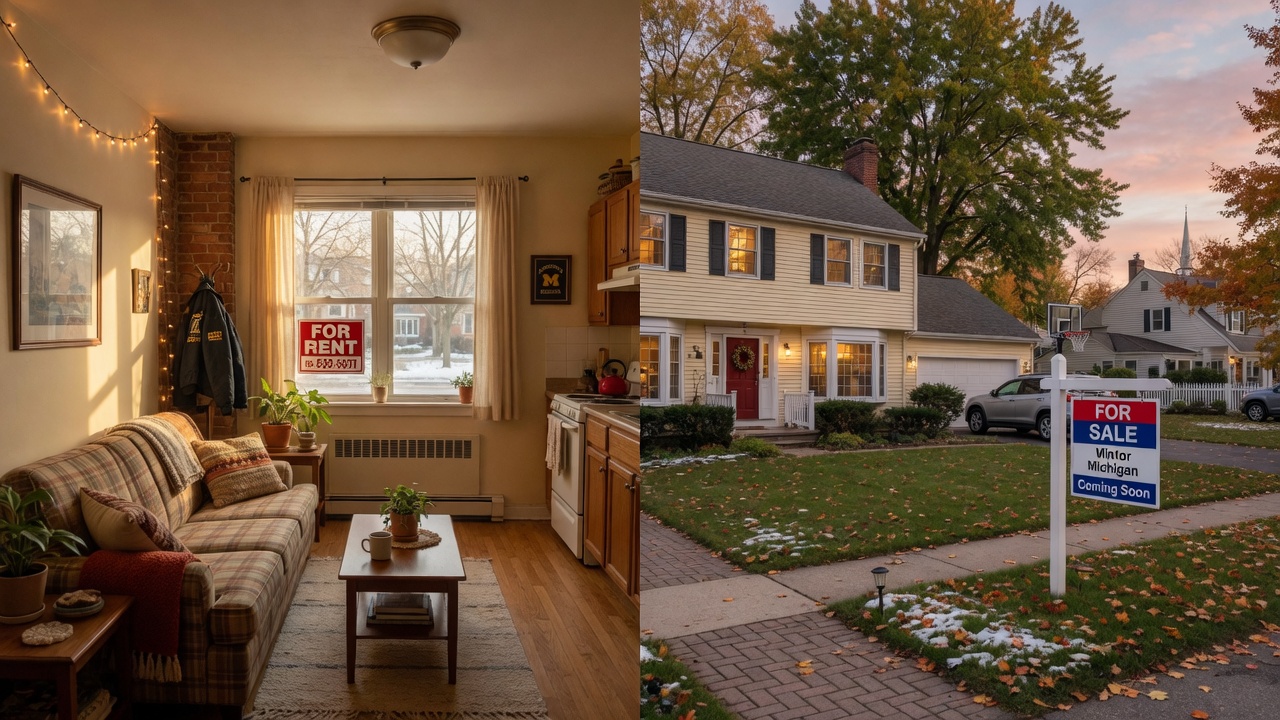
If you've been circling the decision to buy a home but keep wondering whether renting might be the smarter financial move, you're not alone. It's one of the most common questions I hear from buyers in Mid-Michigan — especially first-time buyers and people relocating to the area. The truth is, both renting and buying have real financial advantages, and the right answer depends on your timeline, your goals, and your local market. Let's run the numbers for Mid-Michigan so you can decide with clarity instead of guesswork.
The Monthly Cost Comparison
Let's start with the most immediate factor: what you pay each month.
What Rent Looks Like in Mid-Michigan
As of mid-2026, average monthly rents in Genesee County for houses, condos, and townhomes range from approximately $1,080 to $1,290, depending on the source and property type. Apartment rents average around $1,050 to $1,080, with some areas like Davison averaging closer to $1,125. These numbers are significantly lower than state and national averages, which is one of the reasons Mid-Michigan remains attractive to renters and buyers alike.
For a typical two-bedroom apartment or small rental home, you might expect to pay $1,050 to $1,200 per month. A three-bedroom rental home in a desirable area like Swartz Creek, Grand Blanc, or Davison could run $1,300 to $1,600, depending on size and condition.
What a Mortgage Looks Like in Mid-Michigan
Here's where Mid-Michigan's affordability really shines. As of September 2026, the median sold price in Genesee County sits at approximately $232,750 for single-family homes (RPR). Let's model what a mortgage looks like on a home at that price point:
- Home price: $232,750
- Down payment (10%): $23,275
- Loan amount: $209,475
- Interest rate (approximate): 6.75% (30-year fixed, mid-2026 average)
- Principal & interest: ~$1,359/month
- Property taxes (Genesee Co. avg): ~$225/month
- Homeowner's insurance: ~$125/month
- PMI (if applicable): ~$90/month
Total estimated monthly payment: ~$1,799
That's roughly $500 to $700 more per month than a comparable rental — but here's the critical difference: with every mortgage payment, you're building equity in an asset you own. With rent, that money is gone the moment it leaves your account.
For buyers putting down 20% or more, PMI is eliminated, bringing the monthly payment closer to $1,558 — a much tighter comparison to rental costs. And buyers with excellent credit who lock in favorable rates can reduce that gap further. Understanding how interest rates affect your buying power is essential to running these numbers for your own situation.
Building Equity: The Long-Term Advantage of Buying
The monthly cost comparison tells only part of the story. The real financial advantage of buying is equity — the portion of your home's value that you own outright, which grows over time through two mechanisms:
- Principal paydown. Each mortgage payment reduces your loan balance. In the early years, most of your payment goes toward interest, but over time a larger share goes to principal. After five years of payments on our example mortgage, you'd have approximately $12,000 to $15,000 in equity from principal paydown alone.
- Appreciation. Historically, home values in Mid-Michigan have appreciated at a steady pace. Even modest annual appreciation of 3% on a $232,750 home adds roughly $7,000 in equity per year. Over five years, that's approximately $37,000 in appreciation-driven equity — on top of what you've paid down.
Combined, a buyer who purchases a $232,750 home in 2026 could reasonably expect to have $51,000 to $54,000 in equity after five years. A renter paying the same monthly amount builds zero equity.
That equity isn't just theoretical — it's usable. When you sell, it's cash in your pocket. When you refinance, it can lower your payment. When you stay, it's wealth that continues to grow. The hidden costs of homeownership are real, but they're offset by this wealth-building advantage that renting simply cannot provide.
Tax Benefits of Homeownership
Homeowners may also benefit from tax advantages that renters don't have access to. While every individual's tax situation is different — and you should always consult a tax professional — here are the common benefits:
- Mortgage interest deduction. You can deduct the interest paid on your mortgage, which is significant in the early years of a loan when interest comprises the majority of your payment.
- Property tax deduction. State and local property taxes paid are generally deductible on your federal return, subject to the $10,000 SALT cap.
- Capital gains exclusion. When you sell your primary residence, you can exclude up to $250,000 ($500,000 for married couples) in capital gains from your taxable income — provided you've lived in the home for at least two of the last five years.
- Michigan Homestead Property Tax Credit. Michigan offers a property tax credit for qualifying homeowners and renters, but homeowners often benefit from the Principal Residence Exemption (PRE), which exempts your primary residence from operating millage taxes — a direct, ongoing savings.
These tax advantages don't make buying automatically cheaper than renting in the short term, but they meaningfully improve the long-term financial picture.
When Renting Makes More Sense
Renting isn't the lesser option — it's the right option in certain situations:
- You're不确定 about your timeline. If you might relocate for work within two to three years, the transaction costs of buying and selling (typically 6-8% of the home's value when you include agent commissions, transfer taxes, and closing costs) can eat into or exceed any equity you'd build. Renting provides flexibility that buying doesn't.
- You're not financially ready. If you haven't saved for a down payment, closing costs, and an emergency fund, buying prematurely can create financial stress. A solid financial foundation makes homeownership sustainable.
- You need to repair your credit. Buyers with lower credit scores face higher interest rates, which increase monthly payments and reduce buying power. Taking 12 to 24 months to improve your credit while renting can save you thousands over the life of a mortgage.
- Your lifestyle demands flexibility. Some people genuinely prefer the freedom to move without the responsibility of selling a home. That's a valid personal preference, not a financial failure.
When Buying Makes More Sense
For most people who plan to stay in Mid-Michigan for three or more years, buying makes strong financial sense:
- You're paying rent with no return. Every month you rent in Mid-Michigan, you're paying $1,050 to $1,600 toward someone else's mortgage and equity. Over five years, that's $63,000 to $96,000 in housing costs that builds you nothing.
- Home prices in Mid-Michigan are affordable. With a median sold price of approximately $232,750 in Genesee County (RPR, September 2026), buying in this market requires significantly less upfront investment than in most metro areas. 2026 is a strong time to buy in this market.
- You want stability and control. Homeownership gives you control over your space, your costs (fixed-rate mortgage payments don't increase), and your community. You can renovate, paint, landscape, and invest in your property without asking permission.
- You want long-term wealth building. As we've outlined, the combination of equity paydown, appreciation, and tax benefits makes homeownership one of the most reliable wealth-building tools available to middle-income Americans.
The Real Cost of Waiting
One of the most overlooked financial factors in the rent-vs.-buy decision is the cost of waiting. If home prices in Mid-Michigan appreciate at even 3% annually, a $232,750 home today will be worth approximately $246,900 in two years. That's an additional $14,200 you'll need to finance — plus whatever increase interest rates may bring. Meanwhile, two years of rent at $1,200/month totals $28,800 in costs with zero equity to show for it.
This doesn't mean you should rush into a purchase you're not ready for. But if you've been waiting for the "perfect time," it's worth understanding that time in the market consistently outperforms timing the market.
A Framework for Your Decision
Here's a simple way to think about it:
- Plan to stay 3+ years? Buying almost always wins financially.
- Might leave in under 2 years? Renting probably makes more sense.
- Have 5-10% down payment plus reserves? You're likely ready to buy.
- Need time to save or fix credit? Rent strategically, then buy.
- Want monthly housing costs to stay flat? A fixed-rate mortgage gives you that stability; rent increases annually.
The best decision is the one that matches your financial reality, your timeline, and your life goals — not the one that sounds best in a headline.
Related Reading
- First-Time Buyer's Guide to Mid-Michigan
- The Hidden Costs of Homeownership
- Why Now Is the Time to Buy a Home in Mid-Michigan
- How Rising Interest Rates Affect Your Home Buying Power
- The Complete Guide to Michigan Property Taxes
Let's Run Your Numbers
Every buyer's situation is different, and I'd love to help you evaluate whether buying makes financial sense for you right now. I work with trusted local lenders who can give you a clear picture of what you can afford, and I'll help you understand the full cost of ownership — not just the mortgage, but the closing costs, taxes, insurance, and ongoing maintenance. Schedule a consultation, call me at 810-513-3335, or visit my contact page. Let's make sure your next move is a smart one.

Keller Williams First · 810-513-3335 · Schedule a consultation